Showing posts with label After Dark. Show all posts

Saturday, 22 April 2023

Hilbre Island at Night


 After just over two hours taking star trail images I decided to finish off the evening (it was actually well after midnight) with a few single shot images. The first was a 30/1s exposure with ISO 800, the others are all 15/1s exposures with ISO 1000

I have then adjusted the settings in lightroom to create the final images. In each case I have had to meticulously remove some annoying noise artefacts caused due to the sensor heating up during long exposures but the effort was worth it. The tide had come in while I was shooting and so in these images the surface of the sea has a nice milky smooth appearance as it reflects the light from North Wales and the wind farm on the horizon and Hilbre Island which sits at the mouth of the River Dee. The light from the Hilbre Lighthouse can also be seen reflected.

As these are single shots there is less colour and definition in the stars, and star clusters than I would get if I I had used my star tracker and stacked multiple images but I was not set up for that. I really like the effect that the long exposure has produced. It has given me some ideas of what I can try next time I get out after dark.

Thursday, 20 April 2023

Star Bright


 So after a disappointing night Tuesday I went out again on Wednesday, but to a different location where there was less light pollution in the immediate vicinity and as the sky remained clear I was able to stay out longer.

I managed to get two light trails and a few individual shots (which I will come back to tomorrow).

For the first image I tried to get more of the sky in the shot as there was little in the way of foreground interest. For some reason (carelessness on my part) this was shot at 19mm rather than 17mm which would have been optimal. It was a 58 minute exposure cut short because the camera battery died and due to the added complication of the incoming tide which forced me off the beach and up onto the rocks.

It was quite an eerie sensation listening to the sea bubbling its way across the sand towards me, in near complete darkness. It was only in the last 10 minutes that I could see the water approaching and it was a stark reminder of how fast the tide comes in around here and the dangers of being out on the sand. That being said I was in a nice little bay and the tide at its height only just reached the spot where my tripod had been set up. By the time I had finished my other shots the sea had receded sufficiently that I could walk back on the sand rather than have to clamber over the rocks in the dark with all my equipment.

In the first image I have cleaned it up slightly by removing the light trails of two passing jets which cut across the scene and were a real distraction in the image.

By contrast in the second image (a 61.5 minute exposure shot this time at 17mm) I have left the many aircraft trails in, partly to show how difficult it is to get a clean image but also because with so many crisscrossing trails it looks quite cool. I may try to clean it up at some point that will mean excluding some individual shots from the composite image and that could amount to 9 or 10 minutes worth and could result in gaps in the star trails; we shall see.

As you can see in this image the tide was in and the long exposure has left us with a milky smooth sea. The reflection on the sea is also a composite reflection of the light from Venus over the course of one hour. Venus is the bright white object/line central in the image finishing just above the horizon (it also features in the first image and it should be obvious which one it is).

All in all I had a great time and had I not risked hypothermia I would have stayed out another hour or two. I really hope you enjoy these images and I hope to be able to get out and try some more star trails in future. 

Sunday, 18 September 2022

One Night in Alsace


 I have not long returned from a week's holiday in Alsace, a truly beautiful region of France. We stayed in a fabulous cottage on a hillside 700m above a village called Fraize. On the second night of the stay there was a beautifully clear sky and although the moon was in its third quarter and very bright it was still possible to look up and see more stars than I would ever see in the sky above my home in the North West of England. So of course I couldn't resist getting out there to capture some pictures of the stars.

For the first image I have stacked 22 separate 20 sec shots to try to capture part of the spiral of the milky way. It is far from perfect I know; I did not use enough dark frame shots to reduce noise in the image hence the annoying horizontal line, and of course despite using the tree to the right of the image to mask the moon it was so bright and some of the colours are washed out. Even so the number of stars visible in this shot is incredible.

For the second image I have gone for my second ever attempt at a star trail and I am really pleased with this one...


I took a few test shots to try to get the image framed right. The illumination of the house is entirely from the moon across the valley. The cottage had a security light over the front door and to avoid setting that off I had to climb in and out of the dining room window which was fun especially when I startled a local cat that was hunting in the hedges close by.
This image is a composite of 204 shots each of 30 seconds so taken over a 2 hour period. There was a 3 sec cooling down period between each exposure and I have had to eliminate some shots because of a plane flying through which left an annoying yellow streak through my first attempt at processing this. Actually this was the third attempt because for the first one I was aligning the stars rather than setting up for a star trail so it was very disjointed and I thought I had messed it up. However taking the time to review it meant I finally got it right even though i had been ready to abandon the project altogether. I am so glad I stuck with it and hopefully you will agree that it was worth it.

Sunday, 3 April 2022

Night Skies 2


So here are two more night sky shots from South Stack Lighthouse. They were taken about an hour apart, the first one was a 20 second exposure (ISO 1600,  17mm  F6.3) and the second was a tracked shot with a 60 second exposure (ISO 1600, 17mm F/4.0)

The camera is pointed almost due west and you can see the constellations of Cancer (centre) Hydra (left of centre) and Leo  upper left.

Depending on how large you are viewing these images it is possible to make out a blue cluster of stars (Praesepe) about 3/4 of the way up just right of centre in the first image.

In the second image you can see how the constellations have moved further to the right as the night has progressed.

The bright white light on the horizon in the second image is a Holyhead to Dublin ferry.


Thursday, 13 January 2022

Starry Starry Night


So I have interrupted my intended series of "A Few Days in December" by posting these night sky images that I shot last night and really didn't want to put them off to a later date.
As you can see from the first image (taken using the night sight mode on my Pixel 6Pro) I had set my camera up on the beach using my Sky Watcher Star Adventurer 2i Pro star tracking mount. It really is a cool piece of kit that I am just getting to know.
There have been a couple of nights recently when we were promised clear skies and I have been desperate to get out to shoot the night sky. Last week there was very little moon but sadly too much cloud spoiled things and I couldn't get any good images, I just got very cold for nothing. Although every minute getting to know your kit is time well spent (that's me putting a positive spin on a failed trip).
Last night however the sky was clearer but the moon was more than half full and very bright so as well as the light pollution from Liverpool and Deeside I was up against excess light. Never mind, I am not making excuses and I didn't let that or the biting cold stop me.
In the first image you can see my camera mounted on the tripod and tracking mount pointed north west over Liverpool Bay, the lights along the bottom are from the Burbo Bank wind farm and in the distance you can just make out the shadow of the Pennines in Lancashire. More importantly you can make out a few bright stars, the bright one most central in the image is called "Vega" and top left there are a few from the constellation Cygnus, the bright star at the top is called "Deneb".
The second image is the shot that I captured it is an image comprised of 5 stacked photos using some software called Sequator which is fantastic and so easy to use. Each individual photo was a 2 minute exposure so using this process lots more light is picked up by the camera sensor and more distant objects that the naked eye cannot see become visible. Hence in this patch of sky which has the constellation of Cygnus we can see thousands of stars which are just not there in the first image, if you zoom in you will see what I mean. For reference the brightest star lower right in the second image is Vega. What you also can see in the second image is the range of colours of the different stars and galaxies which are not just white but reds, greens and purple. It really is a beautiful universe.
The third image is also comprised of five stacked images. It is facing south and although the stars are not quite as crisp in this image I really like the picture because the foreground adds context to the overall image. Also I think the stars are probably more recognisable to most people this being "Sirius" (the brightest star lower down in the centre) and the constellation of Orion with the three stars in a line forming Orion's belt and above that are Betelgeuse and Bellatrix. If you look closely you will see more than just three stars along the belt and the three stars below it are actually part of distant galaxies. As this was shot using a wide angle lens I couldn't get more detail of the distant objects but in the future that will be something I will want to explore more. For now I need to hone my skills and practice with the equipment and hope for clear skies.

Sunday, 2 January 2022

Written in Fire?


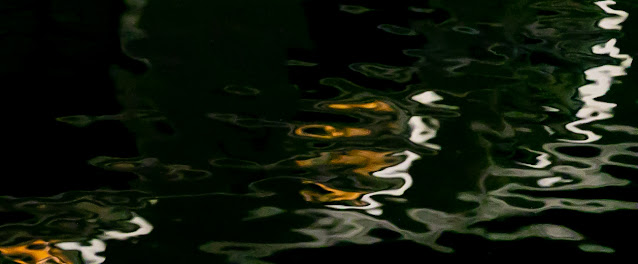
 I know these may n0t be to everyone's taste but I rather like these images. I enjoy looking for the abstract images that can be found in ripples and reflections. I posted some shots on a similar theme on a website about two years ago and got barely any response but about 6 months later I saw very similar posts by other regular contributors who were using the same approach so I thought I may have influenced their own experiment.

Here the shots were taken at night of a hotel sign reflected in one of Bruge's canals, different angles, exposures and crops have produced very different images of the same thing, all of which I think are quite effective and interesting. Water that had appeared flat and smooth is revealed to have lots of movement and miniature peaks and troughs each catching the light and reflecting it back in different ways. Walking by the reflections just look like splashes of light but frozen in time and looked at more closely there is so much detail and beauty to be found in something simple and fleeting.

Wednesday, 29 December 2021

Illuminations


 One of my aims when I was in Alsace recently was to capture some images of the pretty villages after dark. The historic half timbered houses with their varied colours are very photogenic. I have selected just a few images to share with you which I hope you will enjoy.

These are of the pretty town of Kaysersberg which is where I was staying.

Monday, 19 October 2020

Pontoon


Here are a few more shots of the marine lake after dark, these were long exposures to smooth out the ripples in the surface of the lake. It also brought out the detail in the sky and reflections that otherwise would have been missed.


Saturday, 1 April 2017

Skiddaw Under The Stars


Camping at Lanefoot Farm in Thornthwaite was quite an experience and the views of the night sky were quite spectacular.

These two shots were taken from the lane in front of the farm. The first shows the snow covered peak of Skiddaw ( Englands 6th highest mountain at 3,054ft). The alien glow to the left of the image is most likely from traffic on the A66.

The second shot is looking towards Helvellyn (Slightly higher at 3,087ft). The orange glow is from the town of Keswick.

Both images were shot using my Canon 17 - 40mm wide angle zoom using a 30 second exposure. This has allowed just enough of the landscape to be visible and to bring out the stars. The long exposure also gives the clouds a soft, fuzzy almost ghostly appearance.

This was quite early in the evening, later on the galactic centre of the Milky Way would have been visible, although from this spot the light pollution would have spoilt the view. I met a guy the next morning who had been up at Castlerigg Stone Circle at 3am  getting some stunning images so that maybe a trip I will plan in the future.